Data custody
Pick the storage boundary before you upload the archive.
The default is local storage. VoxNotch can also use S3-compatible primary storage, including MinIO, AWS S3, and Cloudflare R2. The product names the boundary because storage is where privacy claims become operational claims.
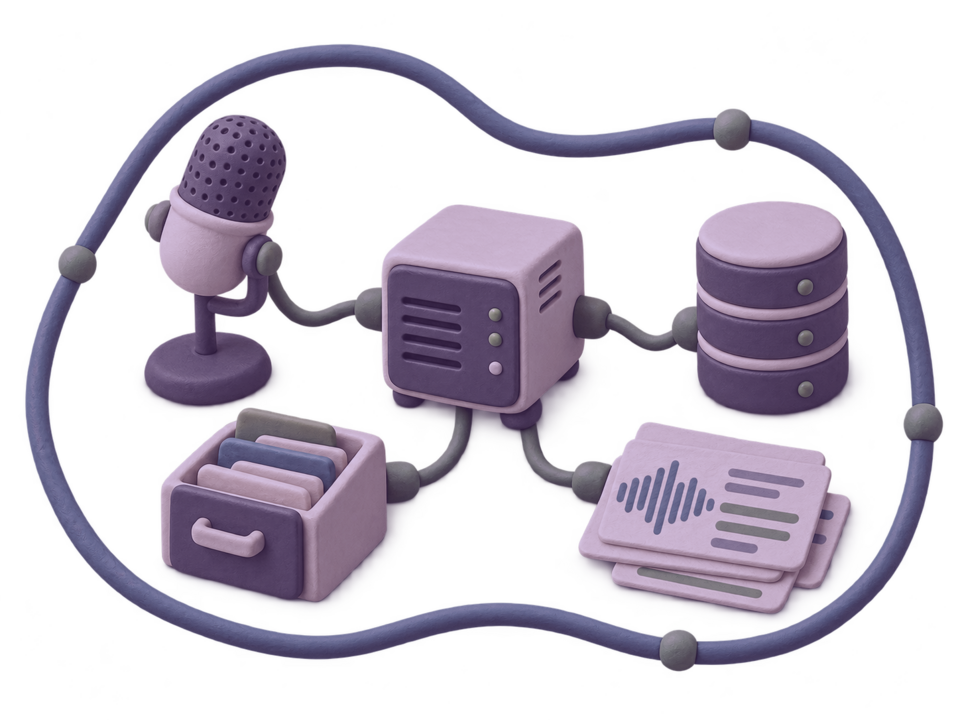
Storage topology: local server, object store, and transcript outputs.
Modes
Local volume, MinIO, S3, and R2.
| Mode | Best for | Custody and backup |
|---|---|---|
| Local volume | Single-host self-hosting, demos, private practice, offline boxes. | No object-store network path. Backups archive the Docker volume or configured storage directory and verify it against a manifest. |
| MinIO | S3-compatible local testing or self-operated object storage. | Still operator-owned when it runs on your network. It is operational egress from the app container to the object store, but not vendor egress unless you host it elsewhere. |
| AWS S3 | Hosted deployments that need durable managed object storage. | Media leaves the app host for AWS. Pair with bucket policy, encryption, lifecycle, replication, and restore drills. |
| Cloudflare R2 | Hosted deployments that want S3-compatible storage without AWS S3. | Media leaves the app host for R2. Use the configured endpoint and test backup/restore against a disposable bucket. |
Last checked 2026-09-01 against the storage and backup runbooks. Remote object storage is always an explicit media boundary, even when the endpoint is S3-compatible.
Backup confidence
What a trustworthy storage backup proves.
Mirror
For local storage, archive the volume. For S3-compatible storage, download the configured bucket/prefix and write a manifest.
Verify
Check the database restore in scratch and verify every archived object against byte size and sha256.
Restore
Practice the destructive restore against disposable database and storage before relying on the backup for real recordings.
Start local. Move storage only when the reason is real.
A local volume is the cleanest first proof. Use MinIO, S3, or R2 when durability, hosted operation, or existing infrastructure makes the extra boundary worth it.