Agentic automation
Let agents operate the workflow, not take custody of the archive.
VoxNotch gives agents and scripts a concrete surface: upload media, poll jobs, inspect transcripts, run recipes, send outputs, and receive webhooks from the instance you operate.
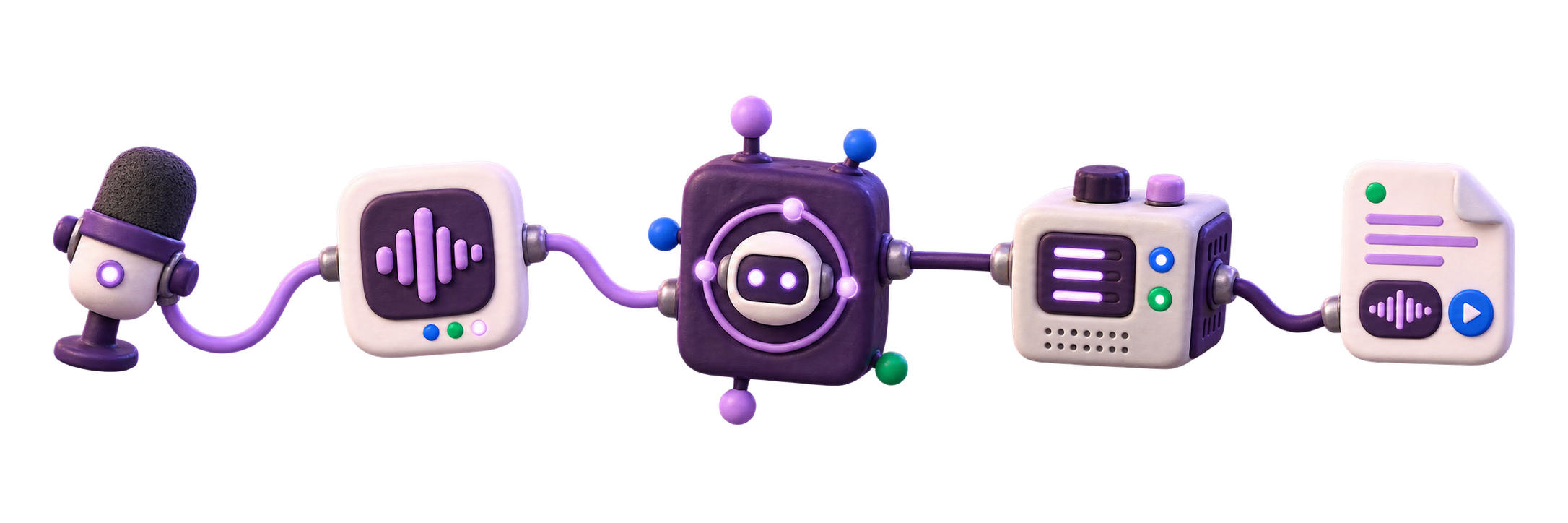
Automation pipeline with API token, local server, webhooks, and recipes.
Agent loop
Give an agent a bounded job with visible outputs.
Ingest and classify
An agent can upload or watch for media, wait for local transcription, tag the result, and place it into the right collection.
Run repeatable recipes
Workflow recipes turn common jobs into repeatable runs: manual clip render, podcast production loops, exports, and webhook notifications.
Agent-friendly surface
curl -sS "$VOXNOTCH_URL/runs" \
  -H "X-API-Key: $VOXNOTCH_API_KEY"

curl -sS -X POST "$VOXNOTCH_URL/workflow-recipes/podcast_studio_production_loop/run" \
  -H "X-API-Key: $VOXNOTCH_API_KEY" \
  -H "Content-Type: application/json" \
  -d '{"recording_id":"rec_...","execute":true}'
The interface is plain HTTP today, which makes it easy for agents, shell scripts, and internal tools to call without a hosted control plane.
Boundaries
Agentic does not mean unbounded.
API keys are scoped. Webhooks and S3 destinations are explicit egress. Hosted LLMs are opt-in. The useful agent pattern is a bounded worker that leaves an inspectable run behind.
Start with one agent-run recipe.
Have an agent upload one file, wait for transcription, run a recipe, and report the output path.