Use cases
The story starts with audio you cannot casually upload.
VoxNotch is one private workspace for recordings that need high-quality transcription, voice design, agentic automation, and publishing workflows without surrendering the original media.
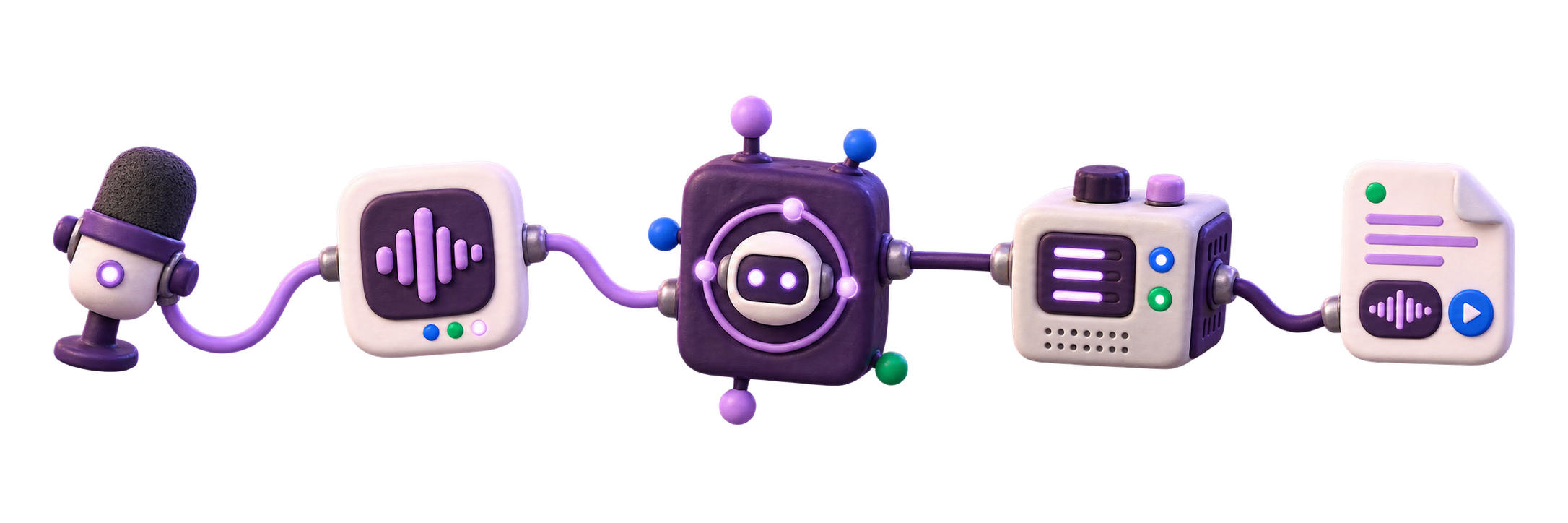
A private audio command center: capture, transcript, voice, automation, and custody.
Buyer journey
The point is not another transcription page. It is a private media operating system.
A recording moves through stages: capture the source, understand what was said, decide what should happen next, and produce the artifact. Most tools split those stages across hosted services. VoxNotch keeps them in one reviewable workflow.
That matters because each handoff is a custody decision. The use cases below are arranged by the moment in the story: sensitive records first, then publishing, voice and language, automation, and the operator layer that keeps it trustworthy.
Workflow map
Follow the recording through the system.
Start where your work actually gets stuck: capture, transcription, archive, production, or automation.
Evaluation guide
What to look for as you compare workflows.
A good trial should leave you with a useful recording, a clear custody decision, and an output your team would actually use.
Transcription quality
Start with one real recording and inspect speaker turns, word timing, search, and correction flow instead of judging from a canned demo.
High-quality local STT is the base layer.
Custody mode
Confirm whether the workflow is local volume, MinIO, S3, R2, or provider-backed before real media enters it.
Remote storage and hosted providers are explicit egress.
Output shape
Check the artifact you actually need: Markdown, JSON, CSV, SRT, VTT, podcast package, clip render, narration output, or webhook event.
Useful workflows end in files or API state.
Operator confidence
For team or hosted use, prove readiness, queue health, storage status, backup verification, and restore rehearsal.
Private software still needs boring recovery.
Sensitive records
Act I: turn sensitive recordings into usable records.
The first promise is simple: the audio becomes searchable and reviewable before it becomes someone else’s data. These workflows depend on speaker-aware transcription, timestamped notes, per-user exports, and a library that still works years later.
Interviews and meetings
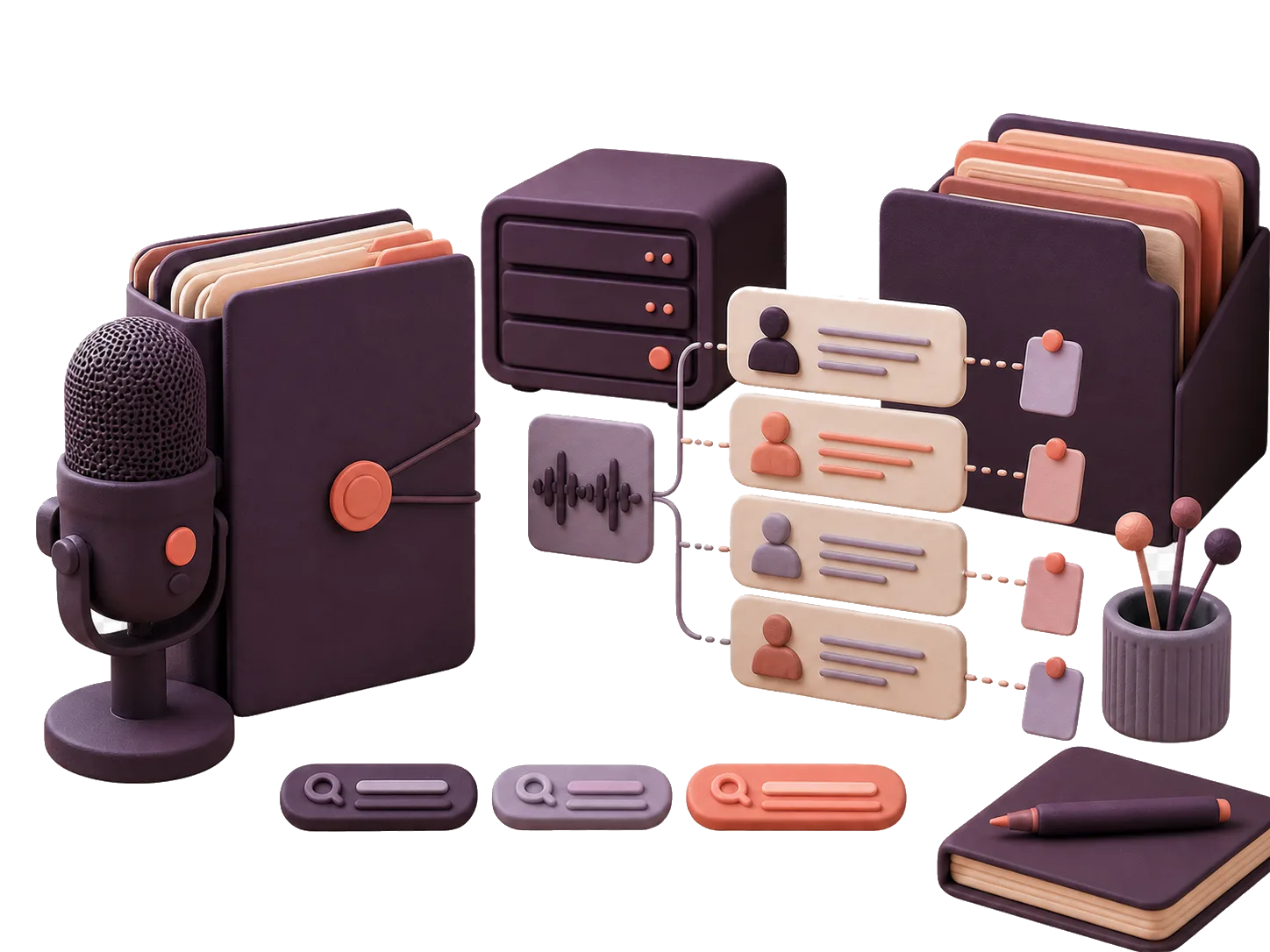
A journalist, researcher, attorney, or internal team records a conversation and needs more than a text blob. VoxNotch keeps the audio, transcript, speaker turns, notes, tags, and exports together so the moment can be cited, reviewed, and found again.
Confidential session records
Therapy, coaching, legal, HR, clinical-adjacent, and advisory sessions need records without surveillance theater. The workflow is local capture or upload, local transcription, notes on the timeline, collections, exports, and an honest statement of what the software does not certify.
Searchable recording archive
A backlog becomes useful when every recording has transcript text, speaker context, source metadata, review state, notes, and collection membership. This is the institutional-memory story: find the moment, not just the filename.
Publishing
Act II: produce finished media from the same transcript.
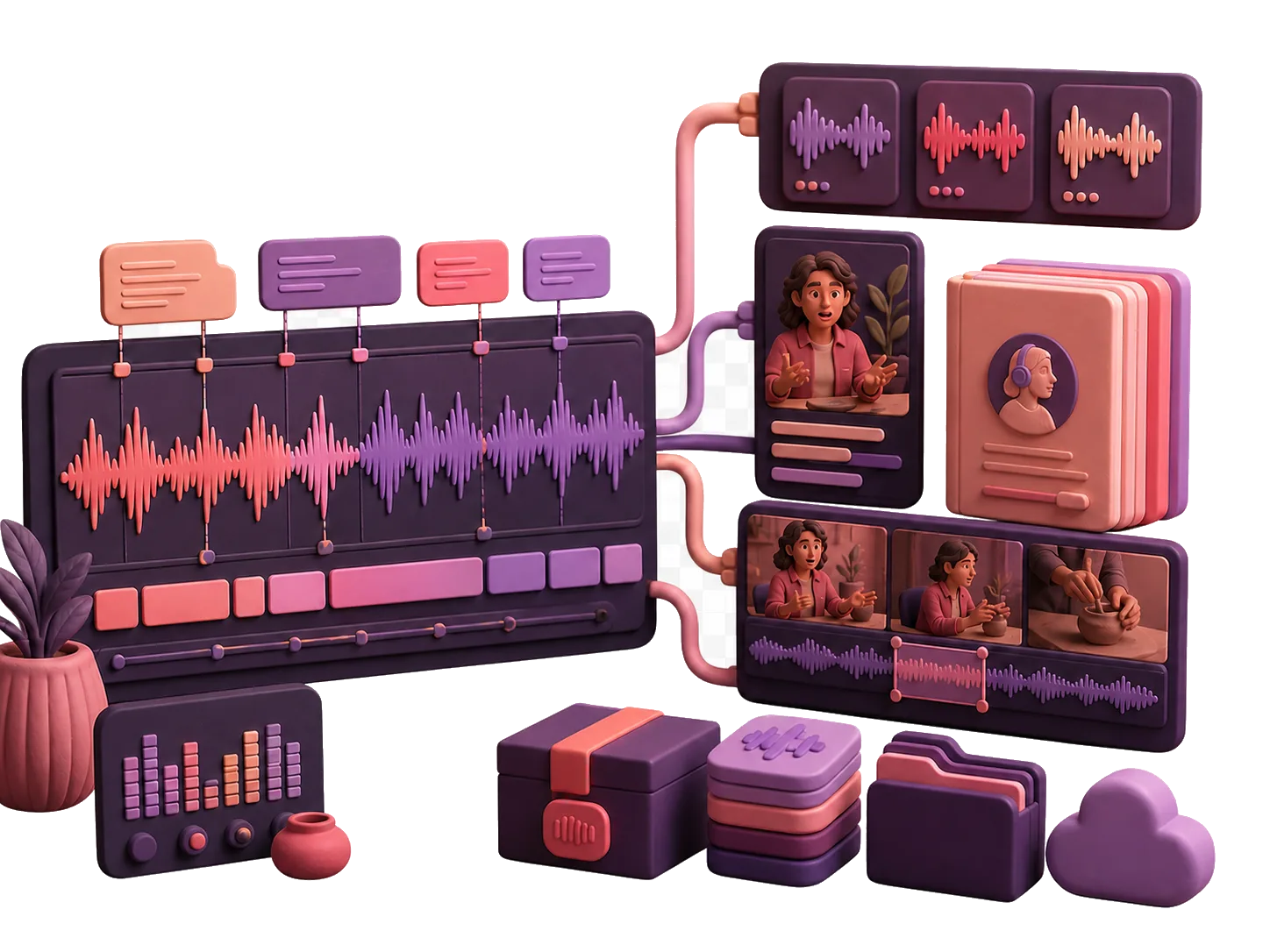
The transcript should not be a dead end. Word timing, chapters, speaker changes, notes, and selected moments become the production layer for podcasts, captions, clips, audiobooks, and delivery packages.
Podcast production
A raw interview becomes an episode: assemble parts, mark chapters, draft show notes, make clips and captions, master to a loudness and true-peak target, export the package, and keep the delivery report with the work. It is the path from source tape to publishable file.
Social clips and audiograms
A highlight becomes a vertical asset without starting over. Select the moment from the transcript, apply word-timed captions, choose a visualizer, add the brand kit, and render for platform-safe dimensions.
Captions and subtitles
A recording becomes accessible media. VoxNotch uses word-timed transcription as the base for reviewable caption tracks, SRT/VTT exports, rendered captions, and correction passes that stay attached to the source.
Audiobook and narration
A manuscript becomes a managed narration project. Chapters queue separately, voices are chosen deliberately, generated audio is reviewed in context, and every output remains attached to the work instead of scattered across prompts. This is the long-form voice counterpart to transcription: scripts, narration, review, and packaging belong in one place.
Publishing search paths.
Persona entry points.
Production pages for buyers comparing specific tools.
Voice and language
Act III: design speech without hiding the custody boundary.
Voice and language workflows need more honesty because quality, consent, model choice, and egress are all in play. VoxNotch keeps those choices visible instead of burying them in a magic button.
Voice design and TTS
Generated speech becomes production work: maintain a voice library, set voice and style parameters, run synthesis in context, review outputs, and keep consent and provenance visible for cloned or provider-backed voices.

Translation and dubbing
A source recording becomes another-language media only after each stage is reviewable: transcribe, translate, choose or generate a voice, align timing, remux, and state clearly when a provider changes the privacy boundary.
Voice and narration search paths.
Technical and production personas.
Automation and operations
Act IV: let systems move the work, while people keep control.
The automation story is deliberately bounded. VoxNotch can watch folders, expose APIs, run recipes, send webhooks, and show operator status, but the run history and custody choices remain inspectable.
Watch-folder transcription
A recorder, NAS, or shared volume drops files into an allowed directory. VoxNotch scans, queues transcription, records ownership, and sends downstream webhooks so a simple folder can become a private ingest bus.
Agentic automation
An agent gets a constrained HTTP surface: upload, wait for high-quality transcription, run a recipe, export or deliver the result, and leave an auditable run behind. Agentic means inspectable work, not unbounded access.
Operator monitoring
The operator sees whether the stack is ready before users depend on it: API, database, queue, workers, storage, models, jobs, backups, restore drills, and incident runbooks. Privacy still needs operations.
Use-case questions
Which VoxNotch use case should I test first?
Start with the recording, output, or automation path that currently creates the most custody risk or manual work. One real file is a better test than a feature checklist.
Are these separate products?
No. They are workflow paths through the same private audio workspace: capture, transcribe, review, produce, automate, and operate.
Join the beta with one workflow in mind.
The strongest evaluation is not a feature checklist. It is one recording, one custody mode, one output, and one automation or operator question you can prove end to end.